
The proxy is the quiet bottleneck in every scraping stack. I ranked 10 providers on network quality, pricing, and how they hold up on protected sites, so you can pick the right one the first time.
Most scraping problems are not scraper problems. Your parser is fine, your logic is fine, and then a third of your requests come back empty because the proxy behind them is overused, slow, or the wrong type for the target. Choose well and the data just arrives. Choose badly and you spend the week nursing retries.
This is a ranked, opinionated look at the best web scraping proxies for 2026, grouped by the job they suit rather than dumped into a flat list. I have run real scraping jobs on several of these networks and compared the rest closely against their technical specs and pricing. The headline: for most teams the best proxy for scraping is the one that gives you a large, reliable residential pool at a price that stays sane as you scale, which is why Proxy-Cheap leads on value. If you have an enterprise budget, two providers go further, and I cover them next.
The quick verdict
Best value overall: Proxy-Cheap
Enterprise heavyweights: Oxylabs, Bright Data
Balanced all-rounders: Decodo (formerly Smartproxy), NetNut, Soax
Specialists and budget picks: Rayobyte, IPRoyal, Webshare, GeoNode
What actually matters when you pick a scraping proxy
Two things decide whether a provider works for you: the proxy type and how the pricing scales. Get those right and the rest is detail.
The type matters more than the brand. Residential proxies use real consumer-ISP IP addresses, so requests look like ordinary home users and hold up best on protected sites. That makes them the default for serious work. Datacenter proxies come from servers, so they are fast and cheap and shine on high-throughput jobs against sites that do not scrutinize datacenter traffic. ISP proxies are static residential IPs hosted in datacenters, pairing residential legitimacy with datacenter speed for long, session-bound tasks. Mobile proxies route through 3G, 4G, and 5G carrier networks and carry the highest trust for the strictest targets. Most real setups mix at least two, so the providers worth your time offer all of them under one account.
On pricing, watch the model, not just the sticker. Pay-as-you-go per GB rewards stop-start and mid-volume work, monthly per-IP suits steady operations, and enterprise contracts only pay off at serious volume. With that framework, here are the 10.
The best value: Proxy-Cheap
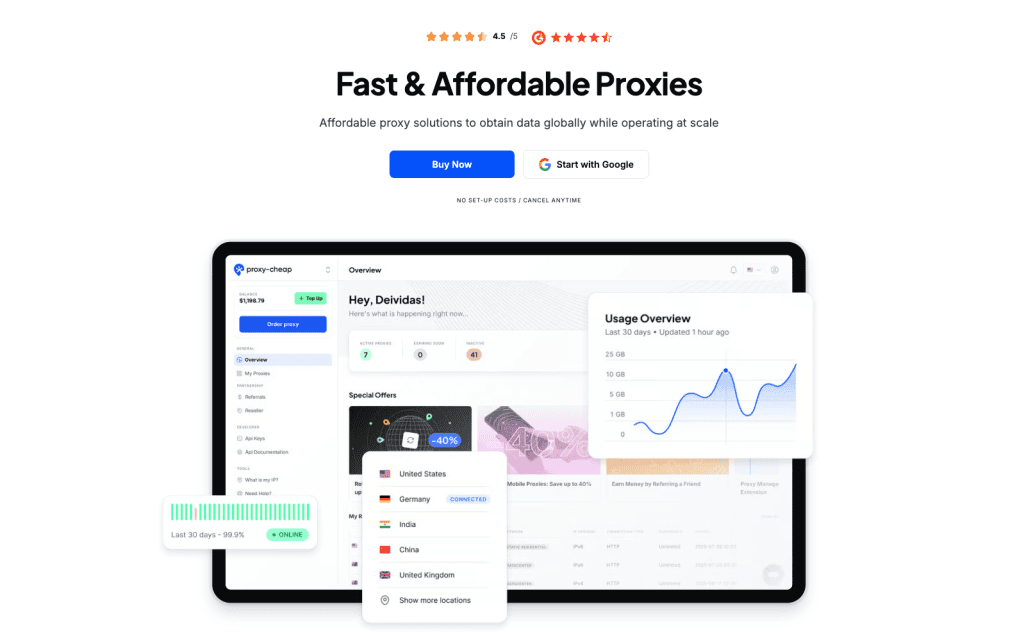
For most people running a first or mid-sized scraping operation, Proxy-Cheap is the one I point them to, because it does the fundamentals well at a genuinely affordable, pay-as-you-go price with no monthly commitment. It runs a large residential network across 180+ countries, and it has earned a base of 45,000+ clients by keeping quality high without the enterprise markup.
What makes it a strong fit for scraping is the breadth on one account, so you can prototype on one type and scale onto another without changing vendors:
Rotating residential proxies with automatic IP rotation, billed pay-as-you-go per GB
Static residential (ISP) proxies that pair residential legitimacy with datacenter speed
Datacenter proxies in IPv4 and IPv6 for fast, economical throughput
Rotating and static mobile proxies on real carrier networks
Unlimited-bandwidth SOCKS5 for sustained high-volume jobs
It supports HTTP, HTTPS, and SOCKS5, gives you session control and rotation options, and wraps it in a clean self-serve dashboard with a public API, Chrome and Firefox extensions, crypto checkout, and 24/7 support. For data scraping specifically, that diverse residential pool plus pay-as-you-go billing is what keeps success rates high while the bill stays predictable as you scale.
Best for: value-conscious scrapers, first-time proxy users, market research, price monitoring, and light-to-medium automation that needs reliable residential IPs without an enterprise contract.
The enterprise heavyweights: Oxylabs and Bright Data
When reliability at massive scale matters more than cost, these two set the bar. They are also the most complex and the most expensive, so they are overkill for a small project.
Oxylabs
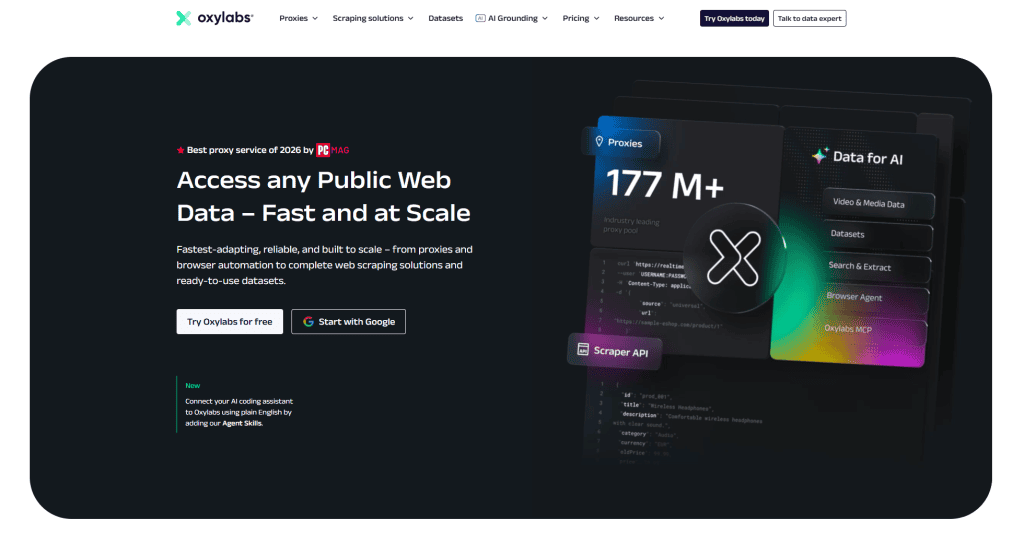
runs one of the largest networks in the category, well over 100 million residential IPs across 195 locations, backed by a Web Scraper API, an AI assistant that turns plain-English prompts into scraping code, headless-browser rendering, and ISO/IEC 27001 certification. Success rates on difficult targets are excellent and the documentation is first-rate.
Upside: an enormous, high-success network with deep tooling and 24/7 support.
The catch: premium pricing and a real learning curve, with a setup that can overwhelm new users.
Best for: large-scale e-commerce monitoring, high-volume SERP collection, and AI training-data pipelines.
Bright Data
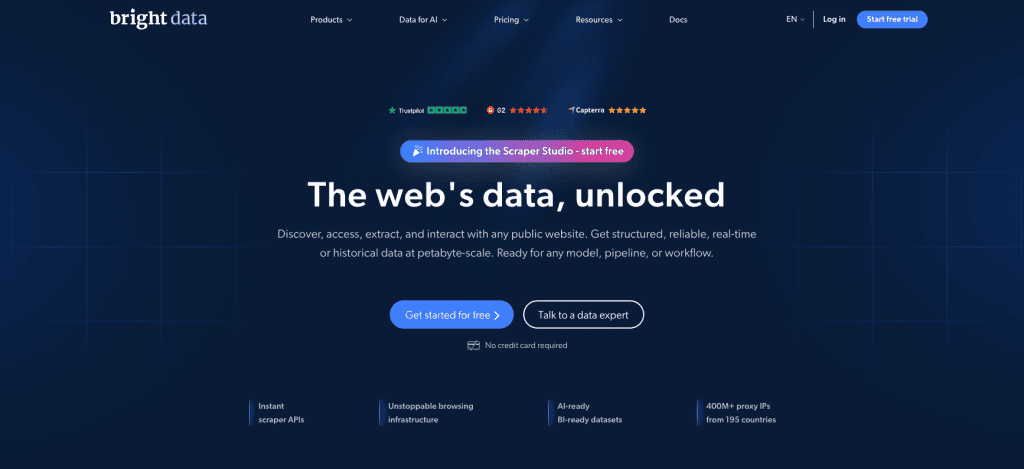
is less a proxy provider than a full web-data platform serving more than 20,000 customers. Its residential pool tops 150 million IPs, with roughly 770,000 datacenter and 700,000 ISP IPs and around 7 million mobile IPs, and its signature strength is precision targeting down to city, ZIP, and ASN. It pairs that with a Web Unlocker that handles CAPTCHAs and anti-bot systems, a Scraping Browser compatible with Puppeteer, Selenium, and Playwright, and 99.99% uptime.
Upside: enterprise-grade infrastructure, the most precise geo-targeting here, and a complete toolset.
The catch: premium pricing, a strict verification process, and a steep, technical setup.
Best for: enterprise teams that need pinpoint targeting and a full data-collection platform and can absorb the onboarding.
The balanced all-rounders: Decodo and Soax
These three sit in the productive middle, more capable than budget tools, more approachable and affordable than the enterprise platforms.
Decodo (formerly Smartproxy)
balances performance with accessibility, offering residential, static residential, mobile, and datacenter proxies plus its own scraping APIs, all behind an approachable dashboard with a reliable pool.
Upside: dependable performance with one of the friendlier interfaces in the category.
The catch: mid-market pricing above budget providers, and less specialized depth than the enterprise platforms.
Best for: medium-sized operations that want steady performance without enterprise complexity.
Soax
is known for a clean, well-maintained residential and mobile pool with granular country, city, and ISP targeting and flexible rotation, which keeps success rates steady on sensitive targets.
Upside: consistent IP quality and precise targeting.
The catch: mid-tier pricing, with the most flexible plans costing more.
Best for: social media data collection and market research that need a clean pool and tight targeting.
The specialists and budget picks: Rayobyte, IPRoyal, Webshare, and GeoNode
Each of these wins in a specific lane rather than across the board.
Rayobyte
is the datacenter specialist, with roughly 300,000 IPs spread across around 20,000 C-class subnets and 9 ASNs to keep large jobs stable, plus ISP, residential, and mobile options, ethical residential sourcing, unlimited-bandwidth datacenter plans, and 1 Gbps lines.
Upside: unlimited-bandwidth datacenter proxies, end-to-end hardware control, and strong success rates.
The catch: ISP proxies run pricier than rivals, different proxy types can mean separate dashboards, the mobile line is narrow, and some users report occasional IP instability.
Best for: datacenter-heavy scraping, SEO and SERP monitoring, and price aggregation.
IPRoyal
is the budget pay-as-you-go pick, with a flexible per-GB residential model, ethically sourced IPs, and traffic that never expires, which is genuinely useful for stop-start projects. It also covers datacenter, ISP, and mobile.
Upside: low cost and non-expiring traffic that carries between projects.
The catch: a smaller network than the enterprise players.
Best for: budget-minded scrapers who want residential quality without a use-it-or-lose-it clock.
Webshare
is the developer’s choice, with a genuinely useful free tier, very cheap datacenter proxies, and a clean self-serve API that makes integration fast. Residential options are there as you scale.
Upside: free to start, cheap datacenter IPs, and a developer-friendly API.
The catch: a smaller residential network, so it shines most on datacenter workloads.
Best for: developers who want to start free, script everything, and lean on affordable datacenter IPs.
GeoNode
keeps things simple with transparent pricing, ethical sourcing, and a pay-per-concurrent-request model, so you only pay for what you use. It offers residential, datacenter, and mobile proxies across 140-plus countries with city-level targeting, HTTP, HTTPS, and SOCKS5 support, sticky sessions from 5 to 60 minutes, and IP whitelisting for up to 20 addresses.
Upside: clear, competitive pricing, a clean IP pool, an easy interface, and responsive support.
The catch: speeds can fluctuate at peak times, the trial is limited, and IPs occasionally resolve to unexpected locations.
Best for: budget residential scraping, e-commerce monitoring, and SERP analysis where predictable pricing matters.
How to choose, by use case
Match the provider to the job:
General scraping on a sensible budget: start with Proxy-Cheap’s residential proxies, pay-as-you-go and reliable across 180+ countries.
Enterprise scale: Oxylabs or Bright Data for the largest networks and deepest toolsets.
Speed and high volume: NetNut for ISP-sourced speed, or Rayobyte and Webshare for cheap, high-throughput datacenter IPs.
Precise geo-targeting: Bright Data or Soax for city and ISP-level control.
Stop-start or credit-based work: IPRoyal for non-expiring traffic, or GeoNode for pay-per-use pricing.
The through-line: residential proxies give the highest success rates on protected sites, datacenter proxies give you speed and low cost on lighter targets, and the best setups keep both within reach. A provider like Proxy-Cheap that offers the full range on one account makes that easy to manage as your needs shift.
FAQ
What are the best proxies for web scraping in 2026?
For value, Proxy-Cheap leads for most projects. For enterprise scale, Oxylabs and Bright Data are strongest. Decodo, NetNut, Soax, Rayobyte, IPRoyal, Webshare, and GeoNode each win a specific budget or use case.
Which proxy services for scraping are best for beginners?
Look for a simple dashboard and pay-as-you-go pricing so you are not locked into a plan while you learn. Proxy-Cheap fits that with a self-serve dashboard, browser extensions, and no monthly commitment, and Webshare’s free tier is a low-risk way to experiment.
Are residential proxies better than datacenter proxies for scraping?
Residential proxies deliver higher success rates on protected sites because they use real consumer IPs. Datacenter proxies are faster and cheaper and work well on sites that do not filter datacenter traffic. Many scrapers run both.
Do I need a paid proxy for scraping, or will free ones work?
Free proxies are slow, unreliable, and risky for real work. A reputable paid proxy for scraping is worth it. Some providers, like Webshare, offer a free tier to start, and Proxy-Cheap’s pay-as-you-go model keeps costs low without a commitment.
How do web scraping proxies keep success rates high?
Large, diverse IP pools plus automatic rotation spread requests across many addresses, so no single IP is overused. Residential and ISP IPs also look like ordinary users, which keeps requests reliable on strict targets.
How much do proxies for scraping cost?
It ranges widely, from budget pay-as-you-go plans to premium enterprise contracts. Pay-as-you-go pricing, like Proxy-Cheap’s, is usually the most economical way to start because you only pay for what you use.

Leave feedback about this